Barcelona’s Soul Is Carved in Stone — You’ve Gotta See This
Walking through Barcelona feels like stepping into a dream where buildings breathe and walls sing. The city’s architectural style isn’t just design — it’s storytelling in stone, shaped by history, rebellion, and genius. From Gothic shadows to Gaudí’s wild imagination, every corner reveals a cultural heartbeat. I didn’t expect to feel so moved by bricks and balconies — but here’s why you will.
The First Glimpse: A City That Defies Expectations
Arriving in Barcelona, whether by train from the French border or by foot from the coastal promenade, one is immediately struck by the city’s visual rhythm. The skyline does not shout; it hums. Sunlight dances across curved balconies and terracotta rooftops, while the air carries the scent of jasmine from hidden courtyards. Unlike other European capitals that unfold in symmetrical order, Barcelona reveals itself in layers — a mosaic of eras, textures, and tones. The first view of Plaça de Catalunya is not merely a junction of streets but a threshold between old and new, where 19th-century arcades stand shoulder to shoulder with sleek modern storefronts.
What sets Barcelona apart is not just its beauty, but the emotional resonance of its spaces. Architecture here doesn’t serve only function — it invites reflection. As visitors step into the Eixample district, they encounter a grid pattern that feels almost mathematical, yet softened by the organic forms of Modernista buildings. The facades ripple like water, balconies curl like vines, and windows glow with stained glass that casts kaleidoscopic patterns on cobblestone streets. It’s easy to walk past these details, but when one pauses, the city begins to speak.
Even in the Gothic Quarter, where narrow alleys twist like ancient roots, the sense of continuity is palpable. Stone steps are worn smooth by centuries of footsteps. Iron lanterns flicker at dusk, casting long shadows on walls that once bordered Roman roads. There’s a quiet dignity in these spaces — a reminder that cities are not built in a day, but shaped over generations. For the thoughtful traveler, Barcelona offers more than sights; it offers presence. The city asks you to slow down, to notice how light falls across a courtyard at noon, or how a single tile mosaic can carry the weight of cultural memory.
Gothic Roots, Modern Twists: The Evolution of Catalan Identity
To understand Barcelona’s architecture is to trace the arc of Catalan history — a story of resilience, creativity, and quiet pride. The foundations of the city were laid by the Romans, whose grid plan still echoes in the Barri Gòtic. Later, under medieval rule, the city grew inward, its streets narrowing like veins to protect against invaders. The Barcelona Cathedral, begun in the 13th century, stands as a testament to this era — a fortress of faith with soaring vaults and delicate tracery. Its cloister, home to a flock of geese said to guard a hidden relic, feels suspended in time.
Yet Barcelona was never content to remain in the past. The 19th century brought industrial wealth, population growth, and a cultural awakening known as the Renaixença — a revival of Catalan language and identity. This renaissance found its most visible expression in architecture. As the city outgrew its medieval walls, a new district, Eixample, was planned with wide avenues and chamfered corners to allow light and airflow. It was here that Catalan Modernisme — the local answer to Art Nouveau — would bloom.
Modernisme was more than an aesthetic; it was a declaration. At a time when Catalonia’s autonomy was limited, architects used design to assert cultural distinctiveness. They drew from nature, mythology, and medieval traditions to create buildings that felt unmistakably Catalan. The city walls may have been torn down, but a new kind of boundary was being drawn — one made of tile, iron, and imagination. Structures like the Hospital de la Santa Creu i Sant Pau, though lesser known than Gaudí’s works, embody this spirit. Designed by Lluís Domènech i Montaner, the hospital complex blends medical function with artistic grandeur, its pavilions connected by underground passages and crowned with colorful domes. It was architecture with compassion at its core — a belief that healing required beauty as much as hygiene.
Gaudí’s Madness and Genius: Architecture as Emotion
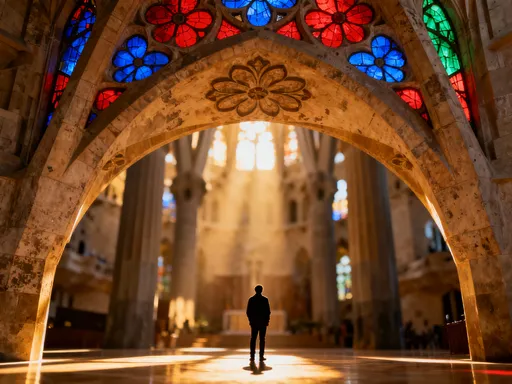
No discussion of Barcelona’s architecture is complete without Antoni Gaudí, the visionary whose work transcends the label of architect and enters the realm of poet. His buildings do not stand; they grow. Sagrada Família, his unfinished masterpiece, rises like a forest of stone from the heart of the city. Its towers, still under construction more than a century after they began, reach skyward like prayer made visible. Inside, columns branch like trees, supporting a canopy of light that shifts with the hours. Visitors often fall silent upon entering — not out of reverence alone, but because the space feels alive.
Gaudí’s genius lay in his ability to merge the sacred with the natural. He studied bones, shells, and tree limbs, translating their forms into arches, vaults, and spiral staircases. Casa Batlló, once a renovated apartment building, now resembles the spine of a dragon, its roof a scaled hump covered in iridescent tiles. The facade undulates like water, and the balconies mimic masks — perhaps of saints, perhaps of sea creatures. It is whimsical, yes, but also deeply serious in its craftsmanship. Every tile was placed with intention; every curve serves both structure and symbol.
Park Güell, originally conceived as a housing estate, became a playground of imagination. Mosaics of broken ceramic — known as *trencadís* — cover benches, columns, and even a giant salamander at the entrance. The park’s colonnaded walkway feels like walking beneath the ribs of a great beast, while the panoramic view of the city reminds visitors that beauty and utility can coexist. What makes Gaudí’s work so powerful is not just its originality, but its emotional impact. People don’t just photograph his buildings — they touch them, lean against them, look up in wonder. In a world of uniform glass towers, Gaudí reminds us that architecture can stir the soul.
Beyond Gaudí: The Unsung Architects of Barcelona’s Skyline
While Gaudí dominates the postcards, Barcelona’s architectural richness lies in its ensemble. Lluís Domènech i Montaner, though less globally recognized, was equally transformative. His Palau de la Música Catalana is a symphony in brick and glass. The concert hall’s ceiling blooms with a stained-glass sunburst, and the stage is framed by sculpted muses and floral motifs. Even the exterior, often overlooked, features intricate tile work and iron letters spelling out “Música.” It was built not for royalty, but for the people — a space where choral societies and workers’ choirs could perform. Architecture, in this vision, was democratic.
Another key figure, Josep Puig i Cadafalch, brought a more scholarly elegance to Modernisme. His Casa Amatller, adjacent to Gaudí’s Casa Batlló on the famous “Block of Discord,” blends Gothic and Nordic influences with Catalan pride. The stepped gable recalls medieval European townhouses, yet the interior is filled with light and modern comforts. Unlike the flamboyance of Gaudí, Puig i Cadafalch’s work feels grounded, refined — a reminder that innovation does not require excess.
These architects shared a belief: that beauty should serve society. Schools, hospitals, and cultural centers were designed with the same care as private homes. The Escola de la Llotja, though older, influenced generations of designers who believed that art and craft were essential to civic life. This ethos continues today in Barcelona’s commitment to public space — from tree-lined boulevards to rooftop gardens in social housing. The city’s skyline is not just a collection of landmarks, but a reflection of values: light, health, community, and the enduring power of art in everyday life.
Everyday Beauty: Hidden Courtyards, Street Corners, and Tile Work
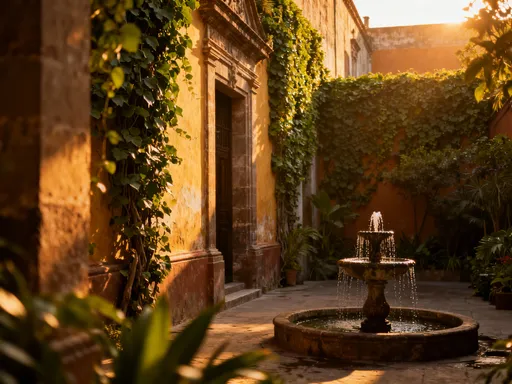
While the grand monuments draw crowds, Barcelona’s true magic often lies off the beaten path. In neighborhoods like Gràcia and Sant Antoni, the city slows down, revealing its domestic soul. Wandering these streets, one discovers courtyards hidden behind unassuming doors — secret gardens where lemon trees grow beside fountains and neighbors gather in the evening. These spaces, known as *patios*, were once central to urban living, offering light, air, and a touch of nature in dense housing blocks.
Look closer, and the details emerge: iron railings twisted into floral patterns, door knockers shaped like hands or animals, tiles arranged in geometric dances. The use of *trencadís* — mosaic made from broken ceramic — turns utility into art. A simple staircase railing becomes a shimmering river of color. Even manhole covers in certain districts bear the insignia of Modernisme, stamped with floral motifs and the four red stripes of the Catalan flag.
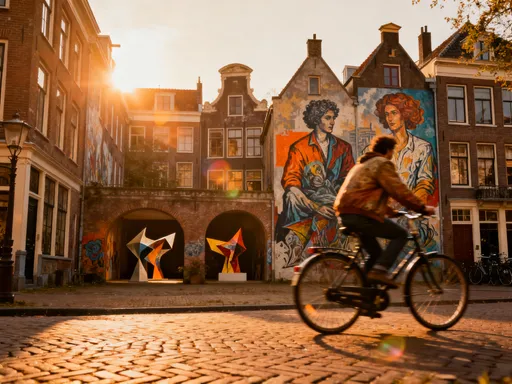
Gràcia, once a separate village, retains a village spirit. Its plazas are alive with local markets, outdoor cafes, and impromptu music. On Carrer Verdi, art studios and family-run bakeries line the street, and building facades display murals that change with the seasons. Here, architecture isn’t frozen in time — it’s lived in, adapted, loved. For the traveler willing to wander without a map, these neighborhoods offer a deeper connection. You begin to see how design shapes daily life: how a well-placed window catches the morning sun, how a shaded arcade offers relief from the summer heat. Barcelona teaches you to notice — and in noticing, to appreciate.
Architecture as Cultural Resistance: Design With a Voice
Beneath the beauty of Barcelona’s buildings runs a quiet current of resistance. In the late 19th and early 20th centuries, Catalonia was undergoing a cultural revival amid political constraints. The Spanish central government often suppressed Catalan language and institutions, yet architects found ways to assert identity through design. Modernisme became a form of silent protest — a way to say, “We are different, and we are proud.”
Every dragon-shaped downspout, every inscription in Catalan, every use of local materials was a statement. Gaudí, a devout Catholic and Catalan nationalist, embedded religious and regional symbols into his work. The Sagrada Família, though a Catholic basilica, also stands as a monument to Catalan aspiration — a project sustained by private donations and local craftsmanship, even during periods of political turmoil. Domènech i Montaner, too, filled his buildings with references to Catalan history and music, ensuring that culture had a home in stone.
This legacy endures. Today, Barcelona remains a city that values its distinct identity. Street signs are in Catalan. Festivals like La Diada celebrate cultural heritage. And the preservation of Modernista buildings is not just about tourism — it’s about memory. When a community fights to restore a neighborhood *modernista* facade, it is not merely saving bricks; it is affirming a worldview that prizes creativity, resilience, and beauty in the face of uniformity. Architecture, in this light, is not passive — it is a form of storytelling, a way of saying, “We were here, and we mattered.”
How to Truly See Barcelona: A Traveler’s Mindset Shift
To experience Barcelona fully, one must shift from sightseeing to seeing. This begins with timing. Visit Sagrada Família in the late afternoon, when the western light floods the nave and sets the stained glass ablaze. Walk the Gothic Quarter early in the morning, before the tour groups arrive, when the only sounds are footsteps and the clink of coffee cups in quiet plazas. These moments offer intimacy — a chance to feel the city before it wakes.
Guided tours can deepen understanding, especially those led by architects or historians who explain not just what you’re seeing, but why it matters. Audio guides at the Palau de la Música or Casa Milà offer insights into construction techniques and symbolic details. But equally valuable is the self-guided walk with a good map — one that highlights not just major sites, but neighborhood gems. Apps like Barcelona Modernisme Route can help trace the evolution of the style across districts.
Most importantly, ask questions. Why does this balcony curve like a wave? Who lived in this building, and what did they value? How does this courtyard make you feel? Barcelona rewards curiosity. When you begin to see architecture not as backdrop but as dialogue, the city transforms. It is no longer just a destination, but a conversation — between past and present, between artist and citizen, between stone and soul.
In the end, Barcelona does not simply show you buildings. It invites you to feel a culture that believes in the power of beauty, the dignity of craft, and the importance of identity. Its streets are lined not just with monuments, but with messages — carved in stone, tiled in color, whispered in the curve of a staircase. You don’t need to be an architect to understand them. You only need to walk, look, and let yourself be moved. Because in Barcelona, even bricks have stories — and they’re waiting to be heard.